
Industrial Benefits of Integrating a PT1000 Sensor
Covers why PT1000 sensing can support temperature control efficiency in industrial systems, including stable readings, equipment feedback, and process monitoring considerations.
Read ArticleVOTESEN RTD Temperature Sensor Supply
VOTESEN supplies PT100 and PT1000 cylinder probe temperature sensors for applications that need stable RTD measurement in equipment, storage, and environmental monitoring systems. The VTS300-style probe can be specified with stainless steel housing, selectable RTD elements, multiple cable materials, and 2-wire, 3-wire, or 4-wire configurations.
For buyers comparing a pt1000 probe manufacturer or qualifying a pt1000 probe supplier, this application page focuses on practical selection points for HVAC systems, cold chain logistics, laboratories, IoT monitoring, automotive electronics, ovens, and industrial control equipment.

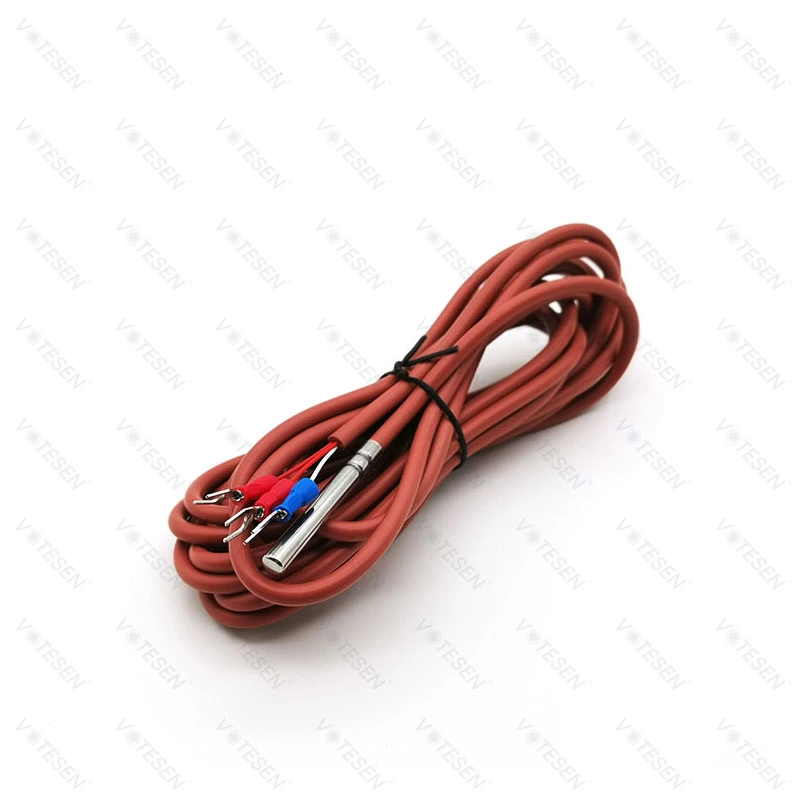
The PT100 PT1000 cylinder probe temperature sensor uses RTD resistance measurement for industrial, laboratory, storage, and equipment monitoring work. According to the product page, it can be built with original IST or Heraeus RTD elements, stainless steel or other housing materials, selectable probe dimensions, cable materials such as PFA, PTFE, silicone, PVC, fiberglass, and stainless steel braided cable, plus connector options including tinned wire ends, aviation plugs, JST, Molex, RJ45, Micro-Fit 3.0, RJ11, and other project-based terminations.
| Product Name | PT100 PT1000 cylinder probe temperature sensor |
|---|---|
| Product Number | No.00120 |
| Model Reference | VTS300 RTD temperature sensor |
| Sensor Type | RTD PT100 or PT1000 temperature sensor |
| Sensor Element | Original IST or Heraeus element according to project requirement |
| Operating Temperature | -200 C to +1000 C, configurable by construction |
| Accuracy Class | Class AA, Class A, or Class B according to measurement requirement |
| Probe Materials | Stainless steel, brass, copper, copper plated nickel, aluminum, ABS, PVC, and other project-based materials |
| Probe Types | Tube, flange, thread, ring lug, needle point, flat surface, or other project-based structure |
| Probe Dimension | Diameter examples include 4 mm and 5 mm; length examples include 30 mm and 50 mm; final size by drawing or application |
| Cable Materials | PFA, fiberglass, PVC, PTFE, silicone, TPE, mica, stainless steel braided cable, and other suitable jackets |
| Cable Length | 1 m, 2 m, 5 m, 10 m, or configured to the buyer's installation |
| Connector Options | Tinned wire end, aviation plug, USB, audio jack, JST, Molex, RJ45, DuPont, XH, CWB, CJT, PH, Micro-Fit 3.0, RJ11, and other options |
| Wiring Configuration | 2-wire, 3-wire, or 4-wire |
| Application Areas | Cold chain logistics, food and beverage storage, pharmaceutical and laboratory monitoring, vaccine storage, automotive, consumer electronics, IoT monitoring, data loggers, HVAC, coffee makers, ovens, barbeque equipment, welding equipment, and industrial electronics |
These VOTESEN articles support buyers comparing PT1000 sensor applications, product-line planning, and deployment requirements across industrial and electronics programs.
Covers why PT1000 sensing can support temperature control efficiency in industrial systems, including stable readings, equipment feedback, and process monitoring considerations.
Read ArticleHelps sourcing teams review PT1000 sensor formats, probe choices, cable and connector decisions, and how a product line can be matched to industrial buyer needs.
Read ArticleReviews deployment points for PT1000 sensors in automotive and consumer electronics systems, including compact installation, signal stability, and application-specific probe builds.
Read ArticleProcurement teams commonly evaluate PT1000 probes through sample testing, installation review, and repeat configuration control before wider sourcing.
5 / 5 rating
We needed a cylinder probe format that could be reviewed across duct sensors, cabinet monitoring, and controller inputs. The quotation process was easier once probe diameter, cable jacket, connector, and 3-wire configuration were listed clearly.
5 / 5 rating
Our team compared PT100 and PT1000 probes for storage monitoring projects. The most useful step was aligning the cable material, lead length, stainless steel probe size, and accuracy class with our data logger requirements.
5 / 5 rating
For equipment accounts, connector consistency matters as much as the RTD element. We reviewed tinned ends, compact connector options, cable strain relief, and repeat dimensions before moving the PT1000 probe into sample evaluation.
Use these questions to prepare a clearer inquiry before selecting PT1000 cylinder probes for application testing or repeat supply.
PT1000 has a higher nominal resistance than PT100, so it can be useful when the control circuit benefits from a stronger resistance change per degree and lower measurement current. Buyers should confirm the input module, cable length, wiring method, required accuracy class, and calibration approach before selecting the RTD element.
A complete inquiry should include RTD type, temperature range, accuracy class, probe material, probe diameter and length, cable material, cable length, wiring configuration, connector type, application environment, and order quantity. These details help the supplier review whether the probe structure fits the equipment.
A 2-wire configuration is simple but cable resistance can influence readings, especially with long leads. A 3-wire configuration is widely used to compensate for lead resistance in many industrial systems. A 4-wire configuration gives stronger measurement control where the instrument supports it and the application needs tighter accuracy review.
Buyers usually review stainless steel probe housing, cable flexibility, insulation material, connector sealing, bend radius, and mounting space. PFA, PTFE, silicone, PVC, fiberglass, and stainless steel braided cable options should be matched to the temperature range, cleaning conditions, moisture exposure, and cabinet or duct layout.
The same RTD technology may support many environments, but the physical probe build should be selected for each use case. Laboratory equipment, food storage cabinets, outdoor ambient monitoring, and machinery all need different reviews for probe diameter, response time, cable jacket, connector type, and mounting method.
Distributors should define standard probe sizes, accuracy classes, wiring choices, cable lengths, connector families, packaging labels, inspection records, and repeat order tolerances. A small set of well-documented configurations can make quoting and reorder planning more consistent across HVAC, cold chain, and equipment accounts.